

As the first day of in-person learning approaches for New York City schoolkids, the city revealed more details about its newly-launched Situation Room, and how parents, students, and school staffers will receive notifications of COVID-19 cases linked to their school.
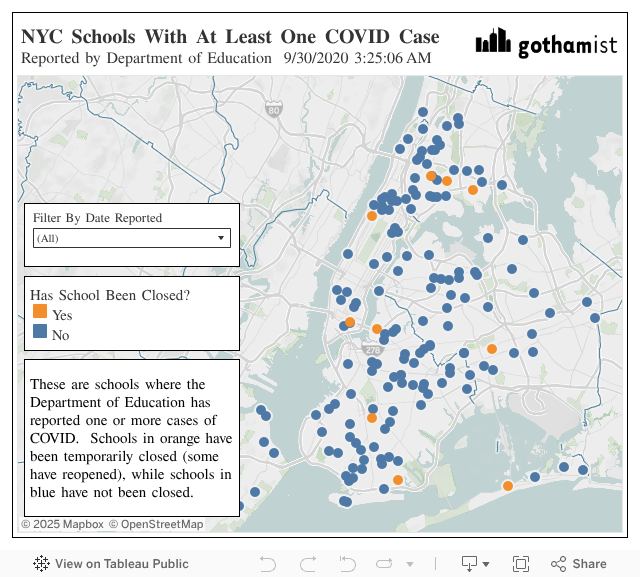
Updated September 19th: The map below shows the schools where the Department of Education has reported one or more cases of COVID-19. Schools in red have been temporarily closed (some have reopened), while schools in green have not been closed.
Mayor Bill de Blasio said on Wednesday the COVID-19 notifications will be available rapidly since the Situation Room, overseen by Department of Buildings Commissioner Melanie La Rocca with staff from the Department of Education, Test & Trace Corps, and the Department of Health and Mental Hygiene Department, has streamlined the process of collecting and verifying test results.
“It is being done a lot more quickly, a lot more effectively, because we have a Situation Room,” de Blasio said at his Wednesday press briefing.
Back in March, as the pandemic spread through New York City, the DOE was criticized for a disorganized and inconsistent approach to notifying school communities of cases before school buildings were closed in mid-March. The coronavirus took a deadly toll on the DOE, where 79 employees ultimately died from COVID-19.
In trying to avoid a repeat of the spring’s chaos when schools reopen on September 21st, the Situation Room will provide a direct hotline for principals to report confirmed or suspected cases, which will then be verified and tracked by officials from the health department (DOHMH).
“It is a very different situation than March. March was horrible for everyone,” de Blasio said, and promised that test results will be confirmed in “minutes.”
“So we have DOHMH, our Test and Trace colleagues, DOE in a space where they’re doing inputting calls from principals. So we get a principal on the phone with us,” La Rocca said at the briefing. “Once we've got the basics of the information, we're passing that along in the system to DOHMH. DOHMH actually has a team that they've assembled who are doing nothing but verifying the cases we're sending to them. So this team is dedicated. They're on site, and they are doing this all day.” The Situation Room will operate from 5:30 a.m. to 9:30 p.m. Monday through Friday, and 11 a.m. to 9:30 p.m. Sunday, she said. For reasons not explained, the Situation Room is closed on Saturdays.
“The whole system is predicated on the verification of the test being done as quickly as humanly possible, then immediately taking the next steps, and we need that to go very fast. And that's why we have a room that's supposed to make those decisions and immediately act on them,” de Blasio said.
On Tuesday, the DOE announced that 56 schools have reported single cases of COVID-19 among staff who returned to school buildings for prep work, and that two school buildings were temporarily closed following DOE protocol to close a school building after reports of two cases in separate classrooms.
Still, the involvement of the Health Department has irked the United Federation of Teachers union, whose president Michael Mulgrew said he blames for the delayed school closures in the spring.
“The Department of Health was not confirming cases, which was then causing schools to remain open without...testing and tracing, and we believe [that] led to more and more people becoming sick,” Mulgrew told reporters in a press call Monday. “So we will not enter into an agreement that says the Department of Health has any jurisdiction over a confirmation of a positive covid case for the city of New York.”
A request for comment from the UFT on the Health Department’s involvement in de Blasio’s Situation Room was not immediately answered Wednesday.


